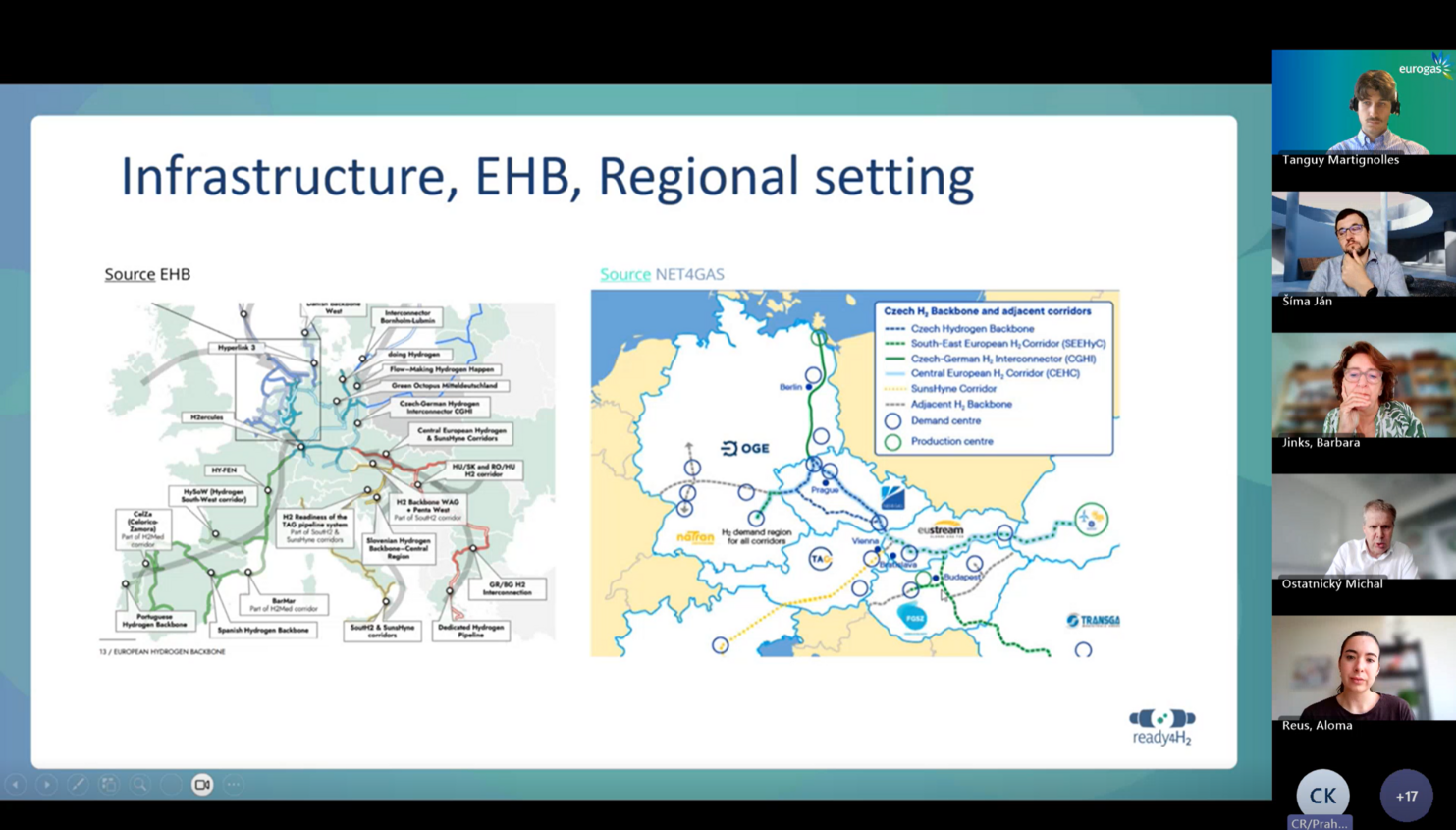
This week Ready4H2 held a webinar on the status of hydrogen developments in the Czech Republic. Gasnet representatves Michal Ostatnický, Senior Specialist Regulatory and Legal, and Ján Šíma, Process Safety Engineer, presented the overview, covering national policy developments, infrastructure planning and projects on the ground. The webinar highlighted the role of hydrogen and the potential repurposing of existing gas networks as viable transition pathways towards a hydrogen economy.
The Czech government‘s approach to H2 is "cautious but active" with tangible progress for H2 implementation underway. While the country faces limited opportunities for large-scale domestic renewable H2 production, policymakers increasingly view this as a tool to decarbonise their chemical industry and reduce emissions from transport. The 2024 National Hydrogen Strategy proposes 3 stages: local islands to meet RFNBO targets for industry, global bridges such as connecting with the European Hydrogen Backbone (EHB) and new technology to increase H2 production. A key part of the Strategy is for natural gas to replace coal for buildings and district heating, that can later be replaced by H2.
Given the country's constrained renewable energy resources, the Czech Republic will need H2 imports to meet REDIII targets. Flows from South and East primarily to Germany and hydrogen from Germany in early stages are anticipated to become a key supplier once the EHB is operational, with current projections for cross-border flows by 2032. GasNet is involved in several hydrogen initiatives including the permanent methane/H2 blending pilot in Hranice (Karlovy Vary Region) and the H2 training and test facility in Pardubice, where the primary focus is on training personnel for safe handling of hydrogen under real-world conditions, alongside planned testing of infrastructure components.
